

7. Comparative Clinical Matrix: Early Red Flags vs. Advanced Manifestations
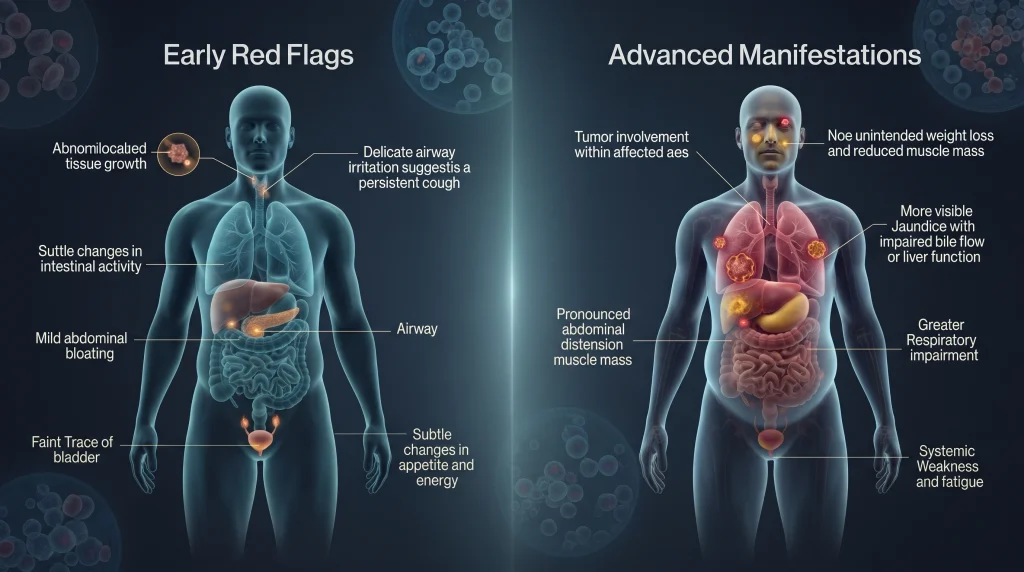
Understanding the transition from early, subtle red flags to advanced clinical features highlights why early evaluation is crucial.
| Cancer Type | Primary Early “Silent” Red Flags | Advanced Clinical Manifestations | Gold-Standard Diagnostic Tools |
| Colorectal Cancer | Narrow stools, alternating bowel habits, occult blood | Severe rectal bleeding, bowel obstruction, palpable mass | Colonoscopy, Fecal Immunochemical Test (FIT) |
| Ovarian Cancer | Persistent abdominal bloating, early satiety, pelvic ache | Gross ascites, severe pelvic pain, bowel obstruction | Transvaginal Ultrasound, CA-125 Biomarker |
| Lung Cancer | Persistent dry cough (>3 weeks), subtle hoarseness | Hemoptysis, severe dyspnea, chest wall pain | Low-Dose CT (LDCT) Scan, Bronchoscopy |
| Pancreatic Cancer | Unexplained weight loss, painless jaundice, back ache | Severe deep abdominal pain, gastric outlet obstruction | Multi-phase CT/MRI, CA 19-9 Biomarker |
| Liver Cancer | Loss of appetite, mild right upper quadrant heaviness | Severe jaundice, ascites, hepatic encephalopathy | Abdominal Ultrasound/CT, Alpha-Fetoprotein (AFP) |
| Bladder Cancer | Painless pink/red urine (hematuria), urinary urgency | Pelvic pain, bone pain, complete urinary blockage | Cystoscopy, Urine Cytology |