
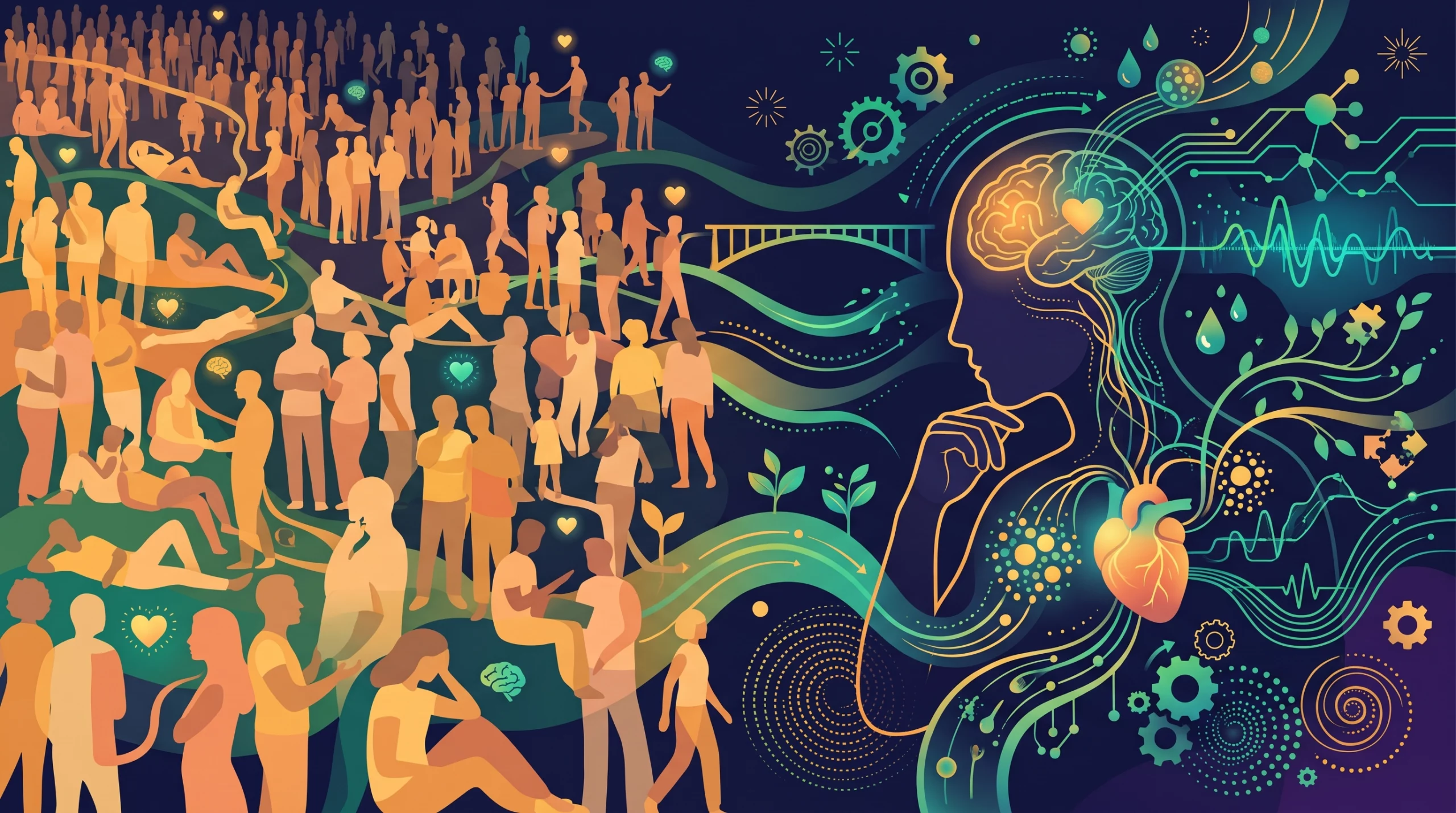
Have you ever felt like the world is facing a collective burnout? If so, you aren’t imagining things. Behind our daily social media scrolls and busy work schedules lies a quiet global crisis: more than 1 billion people worldwide are currently living with a mental health condition.
According to landmark data published by the World Health Organization (WHO), psychological disorders are no longer a niche healthcare issue—they represent the second leading cause of long-term disability on the planet. From anxiety and depression to burnout and severe psychiatric conditions, the demand for care has completely outstripped traditional healthcare systems.
So, how do we bridge a gap this massive? The short answer is scalable care. From artificial intelligence chatbots tested in clinical trials to tele-health platforms and community-based primary care, novel solutions are emerging to reach millions of people who have historically been left behind.
In this article, we break down the eye-opening numbers behind the global mental health crisis, why traditional 1-on-1 therapy alone can’t solve it, and how next-generation digital and community tools are reshaping the future of mental wellness.
1. The Shocking Numbers Behind the Global Mental Health Crisis
When we talk about global mental health, it is easy to get lost in abstract terms. But the data compiled across 144 nations in the WHO’s World Mental Health Today and Mental Health Atlas paints a strikingly clear picture:
- 1 Billion+ Affected: More than 1 out of every 8 people on Earth lives with a mental disorder. The increase in mental health conditions since the year 2000 has outpaced overall global population growth.
- US$1 Trillion Economic Impact: Depression and anxiety alone cost the global economy an estimated US$1 trillion every single year. The vast majority of this cost isn’t from direct medical bills, but from lost workplace productivity, absenteeism, and unemployment.
- 727,000 Lives Lost to Suicide: Suicide remains one of the leading causes of death among young people globally, emphasizing that mental health is a matter of life and death.
- The Treatment Gap: In low-income countries, fewer than 10% of people with mental health conditions receive treatment. Even in high-income nations, over 50% go without receiving formal care.
| Metric | Global Data (WHO & Clinical Reports) |
|---|---|
| Global Population Affected | Over 1 Billion Individuals |
| Annual Economic Cost | US$1 Trillion (Lost Workplace Productivity) |
| Global Workforce Density | Median 13 Mental Health Workers per 100,000 People |
| Annual Spending Disparity | US$65.00/person (High Income) vs. US$0.04/person (Low Income) |
| Treatment Coverage Gap | <10% receive care in low-income nations vs. >50% in high-income nations |
The Huge Funding Disparity
Why is access so limited? Funding is a primary reason. Globally, the median government spending on mental health accounts for just 2% of total health budgets—a figure that has remained virtually unchanged for years.
Furthermore, where you live determines the care you can access. While high-income countries spend up to US$65 per person annually on mental health infrastructure, low-income countries spend as little as US$0.04 per person. Across the globe, there is a median of just 13 mental health workers for every 100,000 people.
2. Why Traditional 1-on-1 Therapy Isn’t Enough on Its Own
For decades, the gold standard of mental health treatment has been weekly 1-on-1 psychotherapy. While sitting down with a licensed therapist for 45 to 50 minutes is deeply effective for those who can access it, relying solely on this model creates systemic bottlenecks:
- The Time Problem: A standard therapist can only see 25 to 30 patients per week. Multiplying that by millions of people in need creates waiting lists that stretch for months or years.
- The Cost Barrier: Out-of-pocket therapy sessions often cost upwards of $100 to $250 per hour, putting care completely out of reach for uninsured or underinsured individuals.
- The Coverage Gap: As noted by health policy experts, a patient getting 45 minutes of weekly therapy is still left alone to navigate the remaining 167 hours and 15 minutes of their week.
To address a crisis affecting 1 billion people, we don’t just need more therapists; we need scalable delivery mechanisms that extend support into daily life.
3. Generative AI & Digital Tools: The New Frontier of Scalable Care
Enter digital mental health technologies. Over the past few years, mobile apps, tele-mental health services, and generative artificial intelligence have transitioned from novelties into clinically tested healthcare tools.
What the Clinical Trials Show: The 51% Breakthrough
In early 2025, researchers at Dartmouth published a groundbreaking randomized controlled trial in NEJM AI evaluating Therabot—a generative AI chatbot fine-tuned with expert clinical guidance.
The trial followed 210 adults experiencing clinically significant symptoms of major depressive disorder, generalized anxiety disorder, or eating disorder risks over a four-week period. The results were eye-opening:
- 51% Reduction in Depressive Symptoms: Participants using the AI chatbot experienced a dramatic drop in depression severity compared to the waitlist control group.
- 31% Reduction in Anxiety Symptoms: Users reported significant improvements in daily worry and nervousness.
- 19% Improvement in Body Image Concerns: Participants at risk for eating disorders showed measurable positive shifts in self-perception.
These findings show that intelligent, fine-tuned digital conversational agents can offer real-time cognitive-behavioral tools and emotional support at any hour of the day—at a fraction of traditional therapy costs.
The Essential Guardrail: Human Supervision
Does this mean AI will replace human therapists? Definitely not.
Regulators like the U.S. Food and Drug Administration (FDA) Digital Health Advisory Committee have emphasized that generative AI agents must operate under strict safety protocols. AI tools are not designed to work fully autonomously in high-risk crisis situations. Instead, the consensus among clinicians and regulators is a hybrid model: AI provides immediate, continuous baseline support and skill-building, while flagging high-risk cases for immediate human clinician intervention.
4. Integrating Mental Health into Routine Care & Communities
Scalable care isn’t just about smartphone apps; it’s also about restructuring how physical healthcare systems treat mental wellness.
Primary Care Integration
Historically, mental healthcare was isolated from general medicine. Today, major progress is happening at the family doctor’s office. World Health Organization reports indicate that 71% of countries now meet international benchmarks for integrating mental health services directly into primary care.
When your regular physician or community clinic routinely screens for depression, offers basic counseling, or prescribes evidence-based care, patients get help early before crises develop.
Community-Based & Human-Rights Centered Models
Global health organizations are advocating for a shift away from long-term psychiatric institutionalization toward community-based care centers. By combining local support networks, peer support specialists, and tele-mental health access, communities can create safety nets that respect individual autonomy and human rights.
5. What Scalable Mental Health Means for You
Whether you are navigating your own mental health journey or supporting a friend, understanding the shift toward scalable care can help you find better resources:
- Explore Digital Hygiene & Self-Guided Tools: Apps and digital programs based on Cognitive Behavioral Therapy (CBT) and mindfulness can offer structured daily support between clinic visits.
- Talk to Your Primary Care Doctor: You don’t always have to wait months for a specialized psychiatrist; your primary care provider is increasingly equipped to guide initial mental health screenings and care plans.
- Support Mental Health Parity & Advocacy: Advocating for equal insurance coverage for mental health—and supporting public investment in community care—helps close the global treatment gap for everyone.
Final Thoughts: Moving from Awareness to Action
The fact that over 1 billion people are living with mental health conditions is a sobering reminder of our shared human vulnerability. But it is also a catalyst for unprecedented innovation. By pairing human clinical expertise with scalable generative AI, tele-health platforms, and integrated community care, society is building a future where mental health support is no longer a luxury for the few, but a fundamental right for all.


2 thoughts on “1 Billion People: Why the Global Mental Health Burden Demands Scalable Care”
Comments are closed.