
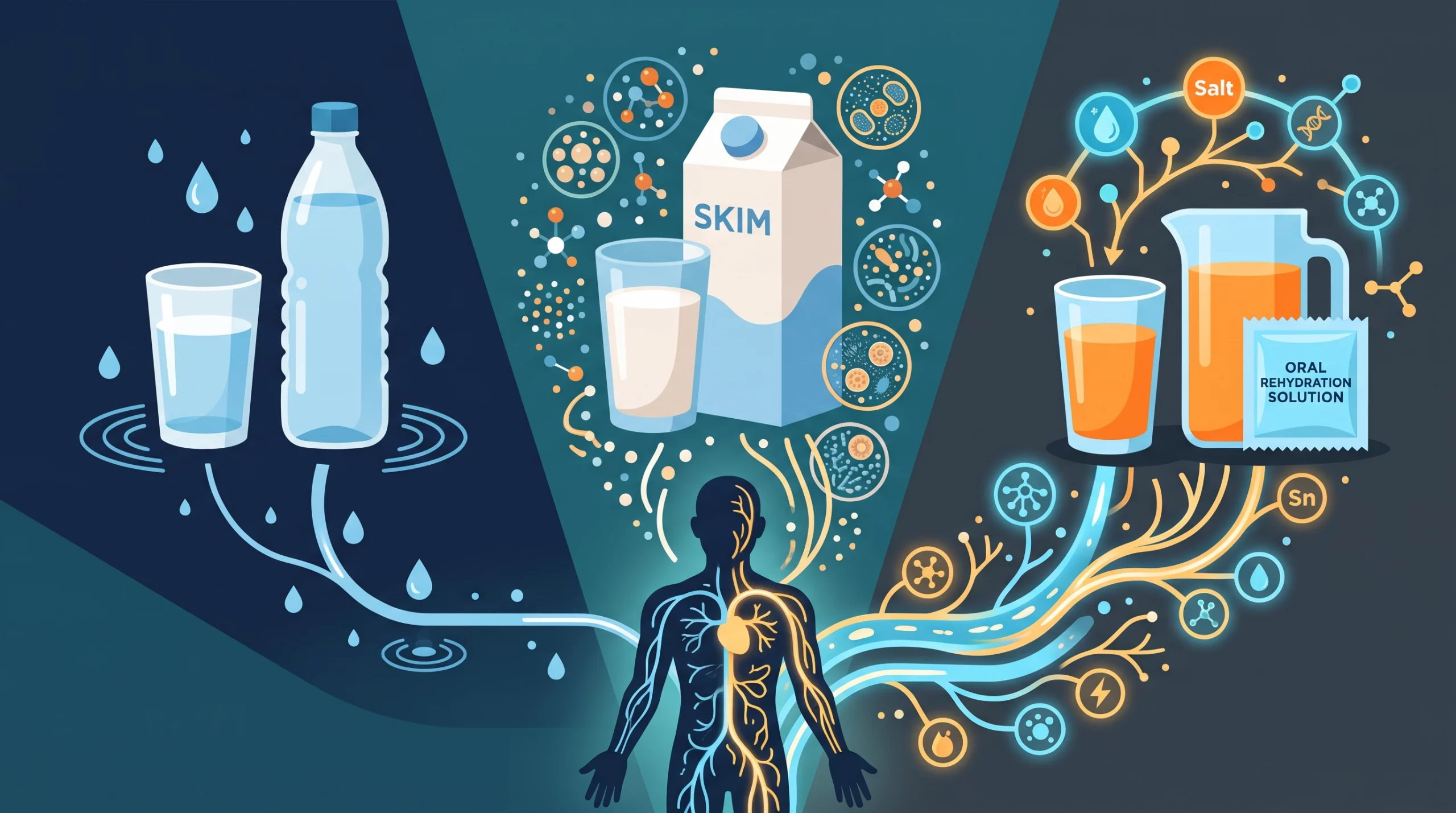
The long-standing public health recommendation to rely exclusively on plain water for daily fluid balance rests on the assumption that water is the universal benchmark for hydration. However, landmark clinical research in human osmoregulation and exercise physiology has reshaped this understanding. While plain water remains essential for daily metabolism, scientific evaluation demonstrates that its rapid passage through the stomach and prompt renal excretion limit its capacity for sustained fluid retention.
When individuals face prolonged periods of fluid restriction, heavy occupational workloads, thermal stress, or environments where frequent urination is impractical, the specific nutritional composition of ingested beverages dictates how effectively the body maintains total body water. By examining the interplay of macronutrients, electrolyte concentrations, gastric emptying kinetics, and neurocognitive responses, contemporary clinical science provides an evidence-based framework for optimizing hydration beyond plain water.
1. Re-Evaluating the Hydration Baseline: The Beverage Hydration Index (BHI)
To establish an objective metric for comparing fluid retention across diverse commercial drinks, a multi-center research initiative led by Professor Ronald Maughan at Loughborough University, alongside investigators at Bangor University and the University of Stirling, established the Beverage Hydration Index (BHI). Published in the American Journal of Clinical Nutrition, the BHI functions analogously to the Glycemic Index, evaluating net fluid retained in the body relative to a standardized control of still water under resting, euhydrated conditions.
In the standardized BHI experimental protocol, healthy, fasted male subjects consume 1\text{ liter} of a test beverage over a 30\text{-minute} period. Cumulative urine mass is collected at hourly intervals over the subsequent 4\text{ hours}. The Beverage Hydration Index is calculated as the ratio of cumulative urine mass passed after consuming plain water to the cumulative urine mass passed after consuming the test beverage at two hours post-ingestion:
\text{BHI}_{\text{beverage}} = \frac{\text{Cumulative Urine Mass}_{\text{Still Water}}}{\text{Cumulative Urine Mass}_{\text{Test Beverage}}}
Under this standardized model, still water is assigned a baseline BHI value of 1.00. A beverage with a BHI significantly greater than 1.00 promotes lower cumulative urine production and superior net fluid balance, demonstrating that a larger proportion of the ingested volume remains within the extracellular and intracellular body water compartments.
Key Clinical Trial Findings
Over the 4\text{-hour} monitoring window, consuming 1\text{ liter} of plain still water produced a mean cumulative urine mass of 1337 \pm 330\text{ g}. In contrast, oral rehydration solutions (\text{ORS}) produced 1038 \pm 333\text{ g} of urine (p < 0.001), full-fat milk produced 1052 \pm 267\text{ g} (p < 0.001), and skimmed milk produced 1049 \pm 334\text{ g} (p < 0.001).
These reductions in fluid excretion yielded substantial mean differences in cumulative 4\text{-hour} urine output compared to plain water:
- Oral Rehydration Solution (\text{ORS}): 362\text{ g} less fluid excreted (95\%\text{ CI: } 222\text{ to } 505\text{ g}; Cohen’s d = 1.09).
- Skimmed Milk: 339\text{ g} less fluid excreted (95\%\text{ CI: } 190\text{ to } 489\text{ g}; Cohen’s d = 0.85).
- Full-Fat Milk: 294\text{ g} less fluid excreted (95\%\text{ CI: } 154\text{ to } 434\text{ g}; Cohen’s d = 1.04).
Consequently, at two hours post-ingestion, skimmed milk achieved a BHI of 1.58 \pm 0.60, oral rehydration solutions achieved 1.54 \pm 0.74, and full-fat milk achieved 1.50 \pm 0.58. These results confirm that nutrient- and electrolyte-dense beverages retain roughly 50\% more fluid in the body than an equal volume of pure water.
2. Physiological Determinants: Gastric Emptying, Energy Density, and Electrolytes
The physiological mechanisms driving superior fluid retention operate across two distinct anatomical stages: fluid delivery from the stomach into the duodenum (gastric emptying) and renal fluid conservation governed by blood osmolality and hormone secretion.
Gastric Emptying and Macronutrient Density
Plain water possesses a near-zero osmolality (2\text{ mOsm/kg}) and lacks caloric energy. Consequently, plain water empties rapidly through the pylorus into the small intestine, triggering a swift surge in vascular volume and a transient fall in plasma osmolality. This hypoosmotic signal suppresses arginine vasopressin (\text{AVP}), prompting rapid renal clearance through diuresis.
In contrast, drinks containing macronutrients—proteins, carbohydrates, and lipids—engage duodenal chemoreceptors and osmoreceptors, slowing gastric emptying in proportion to energy density:
- Caloric Thresholds: High-energy beverages such as full-fat milk (640\text{ kcal/L}), orange juice (470\text{ kcal/L}), and skimmed milk (350\text{ kcal/L}) empty significantly slower than energy-free fluids.
- Carbohydrate and Peptide Co-Transport: Clinical trials conducted at the Georgia Institute of Technology by Millard-Stafford and colleagues demonstrated that adding carbohydrates (6\%) or amino acid dipeptides (2\text{ g/L} alanyl-glutamine) to an electrolyte base significantly increases BHI (1.15 \pm 0.17, p = 0.007 and 1.15 \pm 0.20, p = 0.021, respectively) compared to plain water. Furthermore, these nutrient-enhanced drinks significantly reduced subjective reports of stomach bloating (p = 0.02) compared to plain water boluses.
Electrolyte Osmodynamics and Active Renal Conservation
While caloric density governs the rate of fluid entry into the circulation, electrolyte concentrations—specifically sodium (\text{Na}^+) and potassium (\text{K}^+)—determine whether ingested fluid is retained or excreted.
Sodium in beverages (such as 55\text{ mmol/L} in clinical \text{ORS} or 18–19\text{ mmol/L} in milk) stimulates solute-coupled water absorption across intestinal enterocytes via Sodium-Glucose Cotransporter 1 (\text{SGLT1}) and sodium-dependent amino acid transporters. Once absorbed into the vascular space, sodium remains primarily in the extracellular fluid compartment, maintaining systemic osmolality and blunting the drop in plasma tonicity that normally drives renal water excretion. Potassium, the primary intracellular cation found in high concentrations in milk (40–41\text{ mmol/L}) and orange juice (33\text{ mmol/L}), similarly supports fluid retention within intracellular tissue compartments.
3. Comparative Efficacy Across Beverage Classes
Evaluating hydration properties across diverse fluid categories requires analyzing how specific macronutrient and electrolyte formulations influence overall fluid balance. The following matrix synthesizes findings from clinical trials across multiple academic centers, detailing the composition, calculated BHI metrics, cumulative urine excretion, and primary physiological mechanisms for 13 common beverages.
| Beverage Category | Test Drink | Water Content (%) | Energy Density (kcal/L) | Measured Electrolytes (\text{Na}^+ / \text{K}^+, mmol/L) | 2-Hour BHI Value | 4-Hour Cumulative Urine Output (g) | Primary Physiological Mechanism |
| Baseline Control | Still Water | 100\% | 0 | 0 / 0 | 1.00 \pm 0.00 | 1337 \pm 330 | Rapid gastric emptying; prompt diuresis via transient plasma hypoosmolality. |
| High Retention | Skimmed Milk | 91\% | 350 | 19 / 40 | 1.58 \pm 0.60 | 1049 \pm 334 | Delayed gastric transit via casein/lactose; high potassium & sodium renal conservation. |
| High Retention | Oral Rehydration (\text{ORS}) | 97\% | 80 | 55 / 20 | 1.54 \pm 0.74 | 1038 \pm 333 | Active \text{SGLT1} sodium co-transport; sustained extracellular volume expansion. |
| High Retention | Full-Fat Milk | 88\% | 640 | 18 / 41 | 1.50 \pm 0.58 | 1052 \pm 267 | Slower gastric emptying (lipids/proteins); balanced multi-compartment fluid retention. |
| Moderate Retention | Orange Juice | 89\% | 470 | 1 / 33 | 1.39 \pm 0.46 | 1231 \pm 312 | High caloric density & potassium load; moderate attenuation of post-prandial diuresis. |
| Standard Hydration | Sports Drink (3.9\%\text{ CHO}) | 96\% | 160 | 21 / 4 | 1.09 \pm 0.26 | 1301 \pm 310 | Mild sodium contribution; rapid fluid delivery without significant diuresis delay. |
| Standard Hydration | Cola / Diet Cola | 89–100\% | 0–420 | 2 / 0 | 1.08–1.23 | 1295–1305 | Sugar content delays emptying, counterbalanced by low electrolyte retention capacity. |
| Standard Hydration | Hot Black Tea | 100\% | 0 | 1 / 4 | 1.02 \pm 0.25 | 1320 \pm 295 | Low caffeine dose (179\text{ mg/L}) exhibits zero net diuretic penalty relative to water. |
| Standard Hydration | Black Coffee | 99\% | 4 | 1 / 7 | 0.98 \pm 0.21 | 1345 \pm 310 | Moderate caffeine (212\text{ mg/L}) does not disrupt 4-hour fluid balance in euhydrated adults. |
| Standard Hydration | Lager Beer (4\%\text{ ABV}) | 94\% | 330 | 1 / 6 | 0.98 \pm 0.32 | 1380 \pm 325 | Carbohydrate energy delays emptying, but alcohol-induced \text{AVP} inhibition increases fluid loss. |
Clarifying Caffeinated and Caloric Beverage Dynamics
A widespread health assumption posits that caffeinated drinks like coffee and tea act as acute dehydrating agents. However, double-blind crossover trials evaluating caffeine doses up to 400\text{ mg/L} demonstrate no statistically significant difference in cumulative 4\text{-hour} urine output or net fluid balance compared to plain water (p = 0.83).
While acute, large caffeine boluses exceeding 300–500\text{ mg} in non-habitual consumers can induce transient renal diuresis, standard daily servings of hot tea (179\text{ mg/L} caffeine) or black coffee (212\text{ mg/L} caffeine) contribute to net daily fluid intake with an efficacy comparable to plain water. Similarly, carbonated sparkling water (100\% water content, \text{BHI} = 1.00) behaves identically to still water, confirming that carbonation per se does not alter fluid retention.
4. Neurobiological and Cognitive Consequences of Fluid Shifts
While beverage choice dictates systemic fluid balance, the central nervous system represents one of the most vulnerable target organs to altered hydration status. Neural tissue relies on precise osmoregulation to preserve intracranial volume, neurovascular coupling, and synaptic transmission.
Structural Brain Morphology and Ventricular Expansion
High-resolution magnetic resonance imaging (\text{MRI}) studies show that acute hypohydration—induced via fluid restriction, heat stress, or exercise corresponding to a body mass loss (\text{BML}) of 1.36\% to 2.8\%—causes marked structural changes within the brain:
- Parenchymal Contraction and Ventricular Expansion: Elevated extracellular osmolality creates an osmotic gradient that draws water out of neural cells into the extracellular space. Structural MRI scans analyzed using SIENA at King’s College London revealed that acute dehydration causes subcortical gray matter contraction and parenchymal compaction. To offset this volume reduction within the rigid skull, cerebrospinal fluid (\text{CSF}) cavities expand, showing statistically significant dilation of the lateral ventricles (p = 0.001). Third ventricular expansion correlated strongly with total body mass loss (r = 0.79, p = 0.03).
- Regional Homogeneity (\text{ReHo}) Disruptions: Research in Frontiers in Nutrition evaluated resting-state neural connectivity using the Regional Homogeneity (\text{ReHo}) index. In subjects undergoing 36\text{ hours} of water deprivation (mean urine osmolality 1123 \pm 66\text{ mOsm/kg}), dehydration significantly reduced local neural coherence in key executive hubs, including the right amygdala, right precuneus, and right inferior frontal gyrus (p < 0.01).
- Morphological Recovery Post-Rehydration: Ingesting a 1.5\text{ L} fluid bolus rapidly reverses these deformations. Post-rehydration MRI scans demonstrate widespread gray matter density restoration across the left middle temporal gyrus, cuneus, thalamus, and cingulate gyrus (p < 0.001), alongside white matter density expansion in the corpus callosum and midbrain, and full recovery of regional neural coherence (\text{ReHo}).
Metabolic Inefficiency and Cognitive Performance Metrics
When systemic fluid loss reaches or exceeds 1.5\% to 2.0\% body mass loss, structural deformations impair mental performance and elevate metabolic strain:
- Fronto-Parietal BOLD Hyper-Activation: Functional \text{fMRI} evaluations during spatial planning tasks (such as the Tower of London test) demonstrate that dehydrated individuals exhibit significantly higher blood-oxygen-level-dependent (\text{BOLD}) signal responses in fronto-parietal networks compared to hydrated controls. Due to tissue compaction and reduced cerebral blood flow (\text{rCBF}), the brain must expend higher metabolic energy and over-recruit neural circuits to maintain baseline task accuracy—a state termed neural inefficiency.
- Quantifiable Domain Deficits: Meta-analyses published in PubMed confirm that when fluid loss exceeds 2\%\text{ BML}, cognitive performance declines measurably:
- Sustained Attention & Processing Speed: Latency on the Stroop Color-Word Interference test increases significantly, with reaction times slowing from 28.7 \pm 1.7\text{ seconds} post-hydration to 30.2 \pm 2.2\text{ seconds} during dehydration (p = 0.02). On the Dose-Work assessment, fluid intake elevates reading speed from 339.3 \pm 69.8 up to 486.4 \pm 104.4\text{ items/min} (p < 0.001).
- Working Memory Subsystems: Digit Span test scores drop from 14.3 \pm 1.8 at baseline to 13.3 \pm 1.4 under hypohydration (p = 0.004), with rehydration raising total recall to 15.4 \pm 2.2 (p = 0.001).
- Error Frequency: High-vigilance operational testing reveals a sixteen-fold increase in error rates during dehydration, rising from 0.01\% \pm 0.04\% at baseline to 0.16\% \pm 0.15\% (p = 0.005).
5. Practical Guidelines and Clinical Applications
Applying the science of the Beverage Hydration Index enables health professionals, athletic trainers, occupational safety directors, and clinicians to construct targeted fluid protocols matched to specific operational demands.
1. Context-Specific Beverage Protocol Selection
- Routine Daily Activity: Plain water, carbonated water, and unsweetened black or green tea provide effective baseline hydration for sedentary individuals with regular access to fluids and facilities.
- Extended Shifts and Restroom-Restricted Environments: In occupational settings where fluid availability is limited or frequent urination breaks are disruptive—such as healthcare shifts, long-haul transportation, surgical procedures, or military operations—beverages with high BHI values should be prioritized. Utilizing skimmed milk, oral rehydration solutions, or macronutrient-electrolyte preparations increases 4\text{-hour} fluid retention by 35–50\%, maintaining positive net fluid balance without triggering premature renal excretion.
- Athletic Rehydration and Recovery: While sports drinks containing 4–6\% carbohydrates and 20\text{ mmol/L} sodium replace sweat losses during exercise, recovering athletes benefit significantly from milk-based drinks or milk-permeate solutions post-exercise. The combination of protein, sodium, and potassium aids fluid retention while supporting muscle glycogen and protein synthesis.
2. Biomarkers for Objective Hydration Assessment
Because the subjective sensation of thirst is lag-prone and diminishes with age, population intake guidelines established by the Institute of Medicine (\text{IOM}) and the European Food Safety Authority (\text{EFSA}) emphasize objective monitoring:
- 24-Hour Urine Osmolality: Maintaining 24-hour urine osmolality at or below 800\text{ mOsm/kg} reflects adequate systemic hydration. Values above 800\text{ mOsm/kg} indicate hypohydration requiring fluid intervention.
- Reference Fluid Intakes: Recommended daily total water intakes from beverages and foods are 3.7\text{ liters/day} for adult males and 2.7\text{ liters/day} for adult females under moderate ambient temperatures and typical physical activity levels.
Summary Statement
The clinical evidence established by the Beverage Hydration Index demonstrates that beverage formulation significantly impacts human osmoregulation. While plain water provides effective baseline fluid replacement, beverages fortified with electrolytes (sodium and potassium), carbohydrates, and proteins—most notably skimmed milk and oral rehydration solutions—achieve superior short-term fluid retention by slowing gastric emptying and attenuating renal excretion. Maintaining optimal fluid balance through targeted beverage selection protects brain morphology, prevents ventricular expansion, reduces compensatory neural strain, and preserves executive cognitive function across demanding environments.


1 thought on “Beyond Plain Water: How Skim Milk and Oral Rehydration Solutions Outperform Water in Fluid Retention”
Comments are closed.